How to Read SWE-bench Pro: Why ~58% Is Enough for Serious Engineering
SWE-bench Pro is the coding benchmark people argue about in 2026. That is fair. It is harder and more contamination-resistant than the older SWE-bench Verified set, and it tracks long-horizon, multi-file work closer to real repositories.
What is less fair is treating every point on the leaderboard like it buys the same amount of real-world power. It does not. And for teams that do serious software engineering, with high ownership and a realistic 2× to 3× output lift, you probably need less score than the hype suggests.
Two kinds of "coding with AI"
There is vibe coding: point an agent at a vague goal, let it run for hours, hope something shippable appears. Fun for prototypes. Dangerous as a default for production systems.
Then there is serious engineering with an agent in the loop. You keep ownership. You scope the task. You plan the change with the model before it writes. You review every meaningful decision. The goal is not "walk away for five hours." The goal is a steady 2× to 3× lift while you still understand the system you are changing.
That second mode is how enterprises, and every team that cares about maintenance, actually need to work. Quality helps. Ownership decides whether the project survives.
What SWE-bench Pro is measuring
Scale's SWE-bench Pro asks agents to resolve professional software tasks: multi-file patches, substantial edits, work that can take a human engineer hours to days. Average reference solutions run around a hundred lines across about four files. Trivial one-line fixes are out of scope on purpose.
A score is the share of those tasks the agent resolves under a given harness. Vendor-reported numbers and standardized scaffolds are not always the same race. Harness, tool budget, retries, and which split you evaluate (public, held-out, commercial) all move the number. Read the footnote before you read the headline.
In the syndicAI catalog we bucket those scores into the same tiers you see in the product picker:
- Assistive Coding: 50–55
- Everyday Development: 55–58
- Frontier Coding: 58+
The closed frontier reference on our models page is Claude Opus 4.7 at 64.3. Our open-weight flagship, GLM-5.2, sits at 62.1. This post is about what those numbers mean when you are still in the driver's seat.
How to read the score (not as a flat ladder)
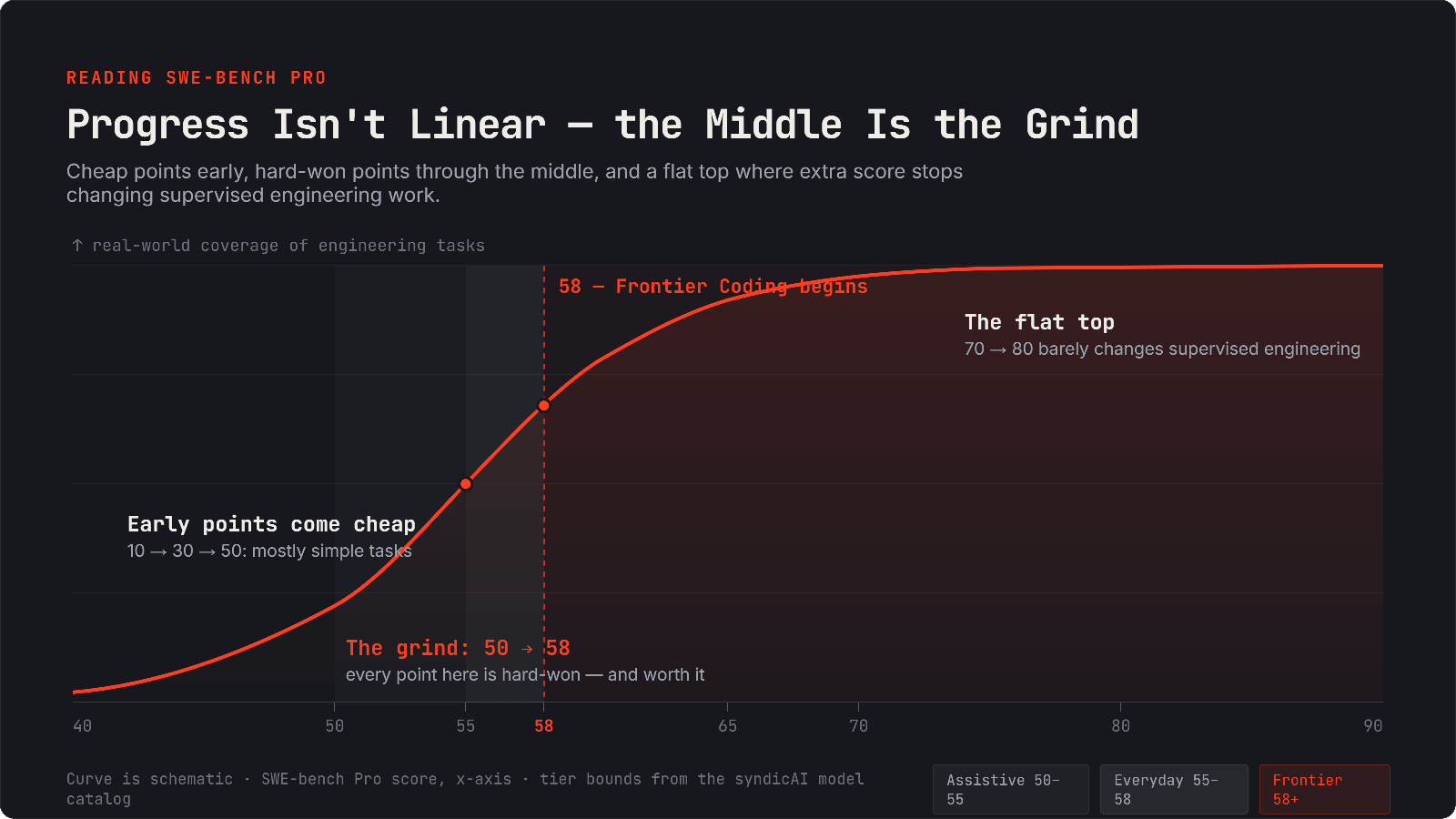
Think of the resolve rate as climbing a difficulty hill, not collecting identical coins.
Early points come cheap. Moving through the simple end of the set (think 10 → 30 → 50) clears work that used to be out of reach. Clearer specs, narrower patches, repositories the model handles well. Progress feels fast because it is.
The grind: 50 → 58. This is where every point is hard-won, and worth it. Scale's own analysis finds resolve rates fall as patches touch more files and more lines. Repository choice matters too: some codebases stay below 10% resolve for every model. Crossing into Everyday, then clearing 58 into Frontier Coding, is expensive capability. Each point means the model is surviving harder, longer-horizon failures.
The flat top. Jumping from the low sixties toward 70 → 80 looks dramatic on a leaderboard. For a human-steered workflow, those last points barely change the work you will actually supervise. You were never going to hand the hardest tail over unsupervised anyway.
This curve is a mental model, not a published density function. Use it when someone waves a single percentage at you.
~58 is the frontier you need. Not 80.
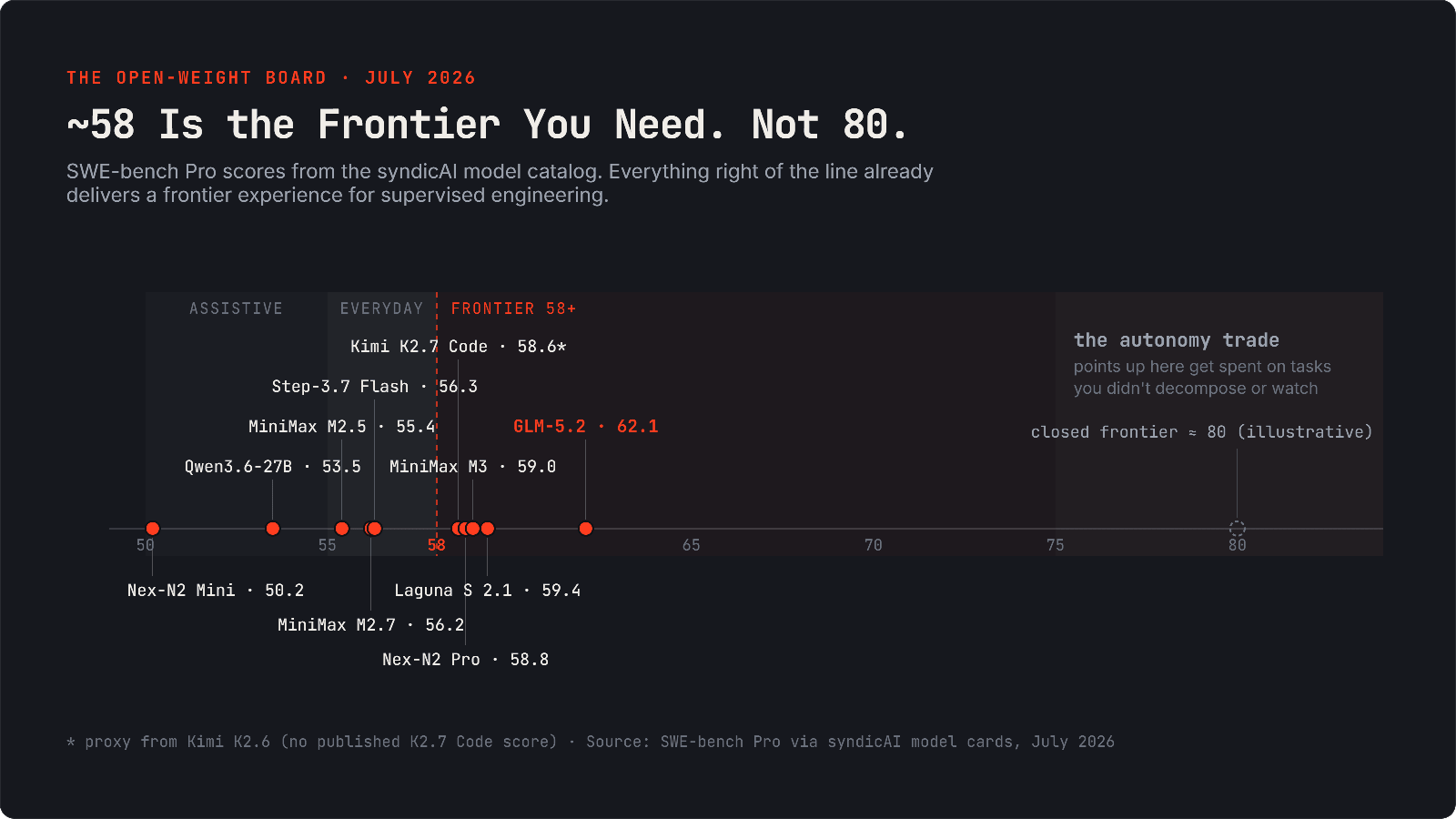
Closed models have posted extreme Pro numbers with specialized scaffolds. Impressive demos. Wrong target for most teams.
Look at the open-weight board as of July 2026. Everything at or right of 58 already delivers a frontier experience for supervised engineering: Kimi K2.7 Code (58.6, proxied from K2.6), Nex-N2 Pro (58.8), MiniMax M3 (59.0), Laguna S 2.1 (59.4), and GLM-5.2 at the top of the board (62.1). Below the line you still get real work done in Assistive and Everyday. Above the ghosted ≈80 marker is the autonomy trade: points spent on tasks you did not decompose or watch.
The open-weight pack did not need to win the autonomy Olympics to become useful. It needed to clear the bar for a sharp engineer who still owns the change.
The honest caveat: the gap from 58 toward the mid-sixties and beyond is not zero. You may steer a bit more. You may decompose tasks tighter. You may correct assumptions earlier. That is not a sacrifice for serious teams. That is the job.
What you trade away, in return for sovereignty, cost control, and data that stays on your node, is a few points of unsupervised reach. What you keep is the thing that actually compounds: understanding of your own system.
The ownership trap at the top of the curve
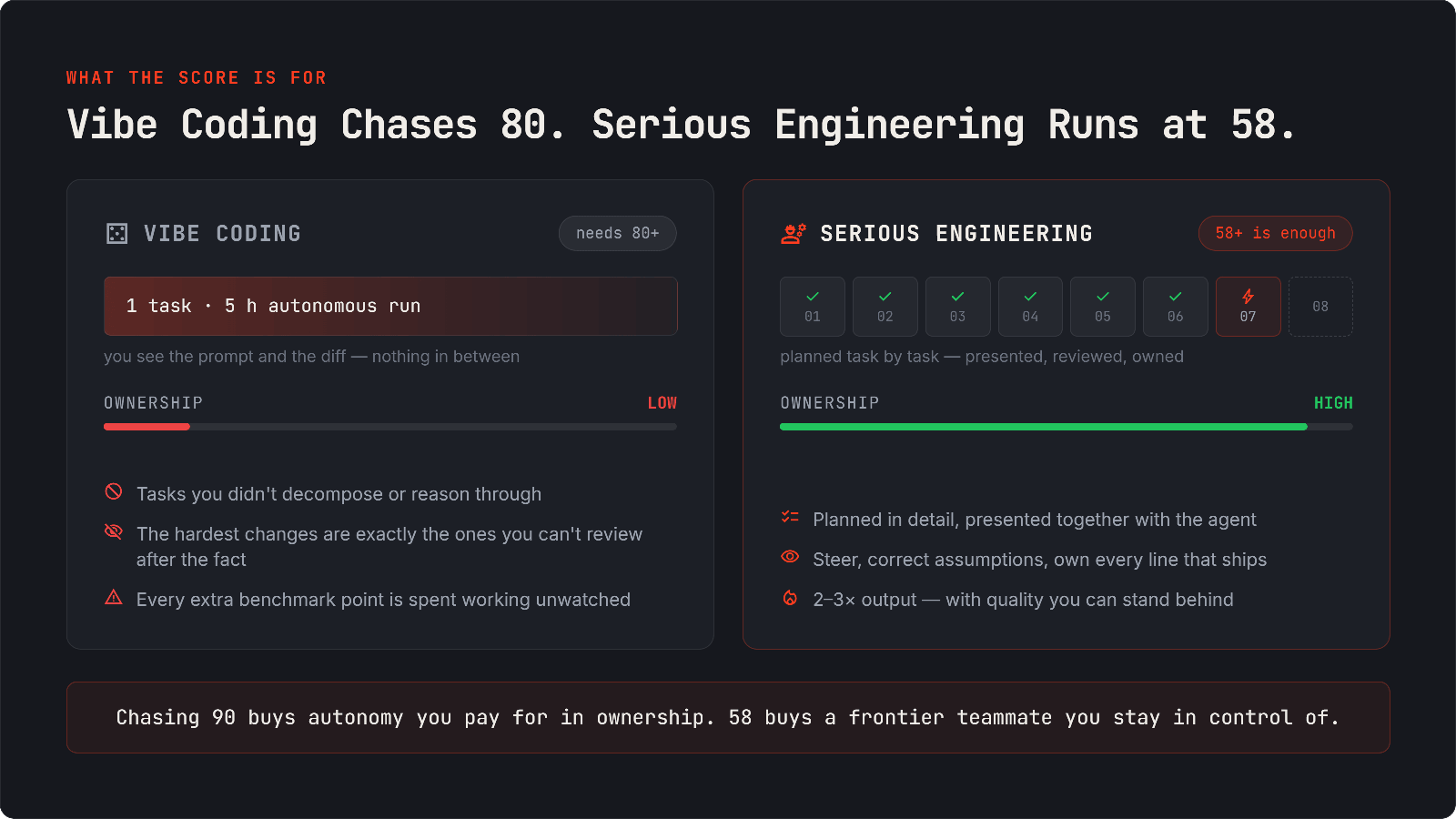
Here is the part the leaderboard never says out loud.
The only way to "use" those last hard points is to let the agent work on tasks you did not fully decompose, did not fully reason through, and often did not watch. That is exactly the tail of the difficulty curve: multi-file, deep-context, hard-to-review changes.
Chasing 80 or 90 so the agent can clear that tail alone is optimizing for the scenario where losing ownership hurts most. If you could not solve it, could not see it, and only accepted the diff after the fact, you did not get a 3× engineer. You got a black box with commit access.
Ownership is not a constraint you tolerate until models get smarter. It is the asset you are protecting. A Frontier Coding model at 58+, on hardware you control, fits that philosophy better than a higher score you only unlock by looking away.
What this means if you pick models for a squad
- Prefer comparable numbers. Same benchmark family, same honesty about harness and source. We publish SWE-bench Pro with the source string next to every catalog score for that reason.
- Optimize for the steered workflow. If your process is plan → implement → review, anything in Frontier Coding (58+) is already in the productive zone next to today's closed frontier reference.
- Spend discipline where the score cannot. Task scoping, tests, and review catch the failures that another ten leaderboard points pretend to erase.
- Put the weights where your code can stay. On syndicAI, token data stays on your GPU node. The control plane handles billing and lifecycle. That matters more than winning a half-point on a public leaderboard.
The score that matters
SWE-bench Pro is useful. Read it as a map of task difficulty, not as a race to ninety.
For serious software development, you already have models that clear the threshold that matters: strong enough to multiply a careful engineer, not magical enough to replace one. The open-weight frontier in our catalog starts at 58 and runs through GLM-5.2 at 62.1, within shouting distance of Claude Opus 4.7 at 64.3.
Keep ownership high. Plan the task. Steer the agent. Ship the change you still understand.
If you want that setup on a shared GPU server instead of another metered API tab, join early access.